The Investment Zone
A4Corridor Overview
The A4 motorway connects Germany to Ukraine through southern Poland. The segment between Wrocław and Opole has become one of western Poland's most concentrated industrial corridors — with €3.8 billion in confirmed investment within a 30 km radius.
Strategic Position
Between Two Major Cities
The corridor sits on the A4 motorway between Wrocław (metro population 1.1 million) and Opole (metro population 300,000+). This positions any facility within reach of 1.4 million people for labor recruitment, with direct motorway access to both cities and the broader European road network.
The A4 motorway runs from the German border at Zgorzelec through Wrocław, Opole, Katowice, and Kraków to the Ukrainian border — connecting Western Europe to Eastern markets through a single uninterrupted route.
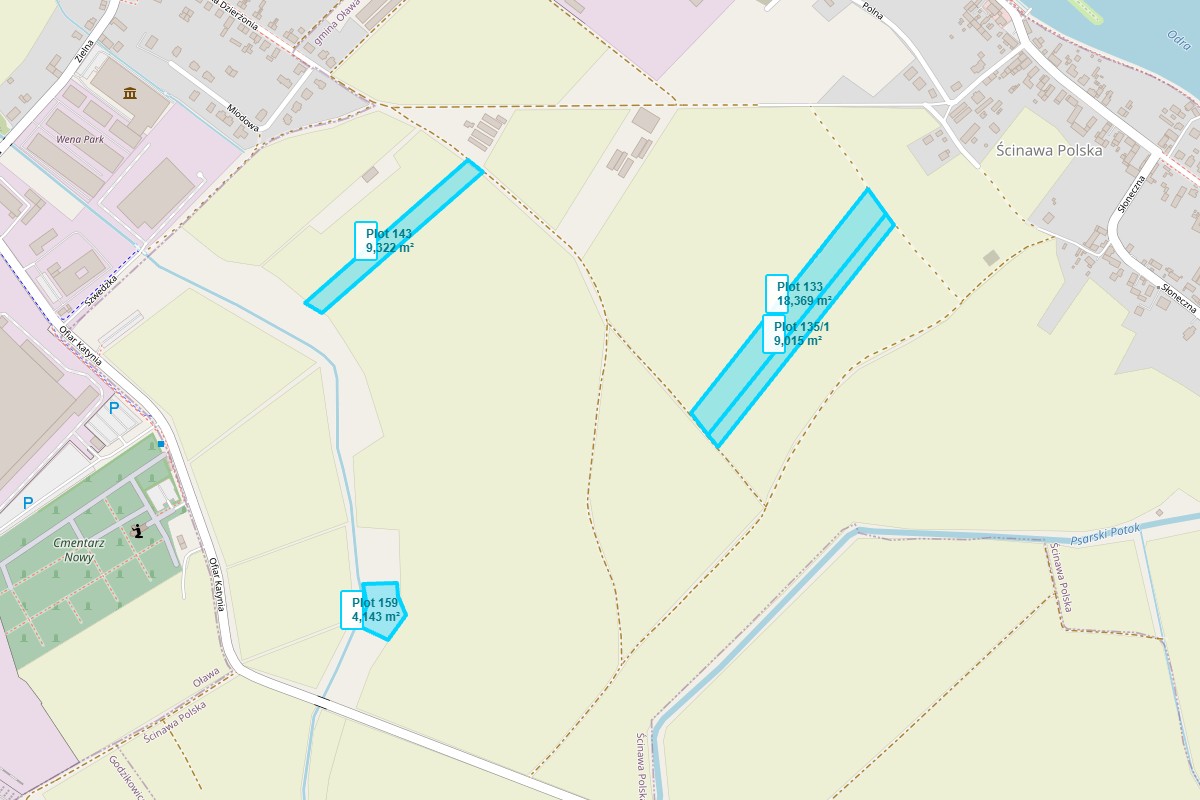
Plot boundaries on street map — Ścinawa Polska
Supply Context
Available Land Is Contracting
The Wrocław-area industrial construction pipeline has declined by 94% — from 586,000 m² to 36,000 m². Major developers like Panattoni have shifted 45% of their portfolio to brownfield conversions, reflecting the scarcity of suitable greenfield sites.
"Suitable, well-located greenfield land has become scarce."
— AXI IMMO, Industrial Market Report
Nearby industrial zones are approaching capacity. The Stanowice SEZ has approximately 25 hectares remaining. The Siechnice industrial zone is fully allocated. Available production-zoned land with permanent MPZP zoning, road access, and utility connectivity is increasingly rare in the Wrocław corridor.
Investment Concentration
€3.8 Billion in Confirmed Projects
The corridor's €3.8B investment figure is derived from 15+ documented projects across manufacturing, defense, infrastructure, and energy sectors. This concentration of capital creates momentum — infrastructure improvements drive land values, which attract further investment, which drives further infrastructure development.
Twelve of these projects are infrastructure investments totaling €355M+, currently in various stages from planning to completion. Each project individually improves connectivity, capacity, or utility access for operations in the corridor.